Insight
Physical AI refers to AI that understands the physical world, makes the right decisions, and acts on them. And on-device AI plays a key role for it.
Sungmin Woo
2026년 5월 28일
Hello, this is ENERZAi. “Physical AI” has become one of the hottest keywords of the moment. It’s a staple of conference keynotes, and the topic visitors most often bring up at our booth. In this post, we’ll take a quick look at what Physical AI actually is and what technologies are needed to make it work.
TL;DR
From NVIDIA’s GR00T to the humanoids from Figure and Tesla, all the way to AMRs and autonomous vehicles on factory floors and city streets, “Physical AI” is no longer a single technology. It has become an industry-wide paradigm.
Physical AI refers to AI that understands the physical world, makes the right decisions, and acts on them. Korea’s ICT R&D classification framework organizes the core technologies behind Physical AI into five categories: VLA models, on-device AI, body technologies, simulation-based training environments, and the Physical AI data factory.
Among these, on-device AI is the final step that runs trained policies in real time at the edge. A non-negotiable prerequisite for perceiving and acting on real-world problems as they happen.
Across the domains where Physical AI is being deployed, including autonomous vehicles, humanoids, and service/care robots, voice user interfaces are becoming the de facto standard. And for natural conversation with AI to actually work, on-device implementation is essentially mandatory across cost, data sensitivity, and real-time performance.
ENERZAi delivers voice user interfaces that run with minimal memory and power, so they perform reliably even in resource-constrained on-device environments.
What is Physical AI?
Over the past year, “Physical AI” has been one of the most frequently mentioned keywords in the global tech industry. NVIDIA officially declared the “Physical AI era” at GTC with the announcement of GR00T, its humanoid foundation model, and the core of the humanoid commercialization race that Figure and Tesla are pushing forward also comes down to Physical AI. Add autonomous vehicles, industrial AMRs (autonomous mobile robots), and drones to the mix, and you can see why attention to “AI that physically moves and reacts”, rather than “AI trapped behind a digital screen”, is at an all-time high.
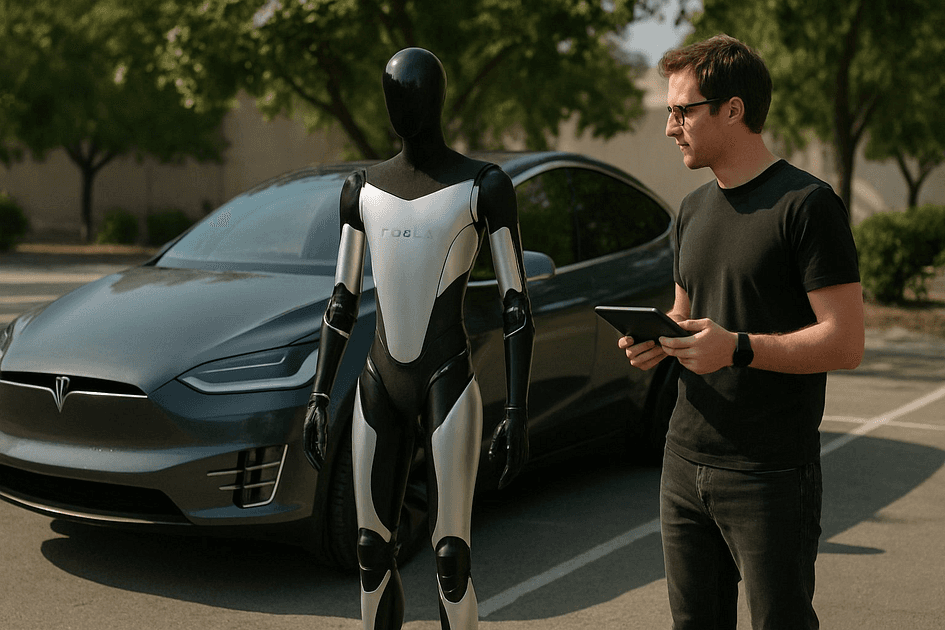
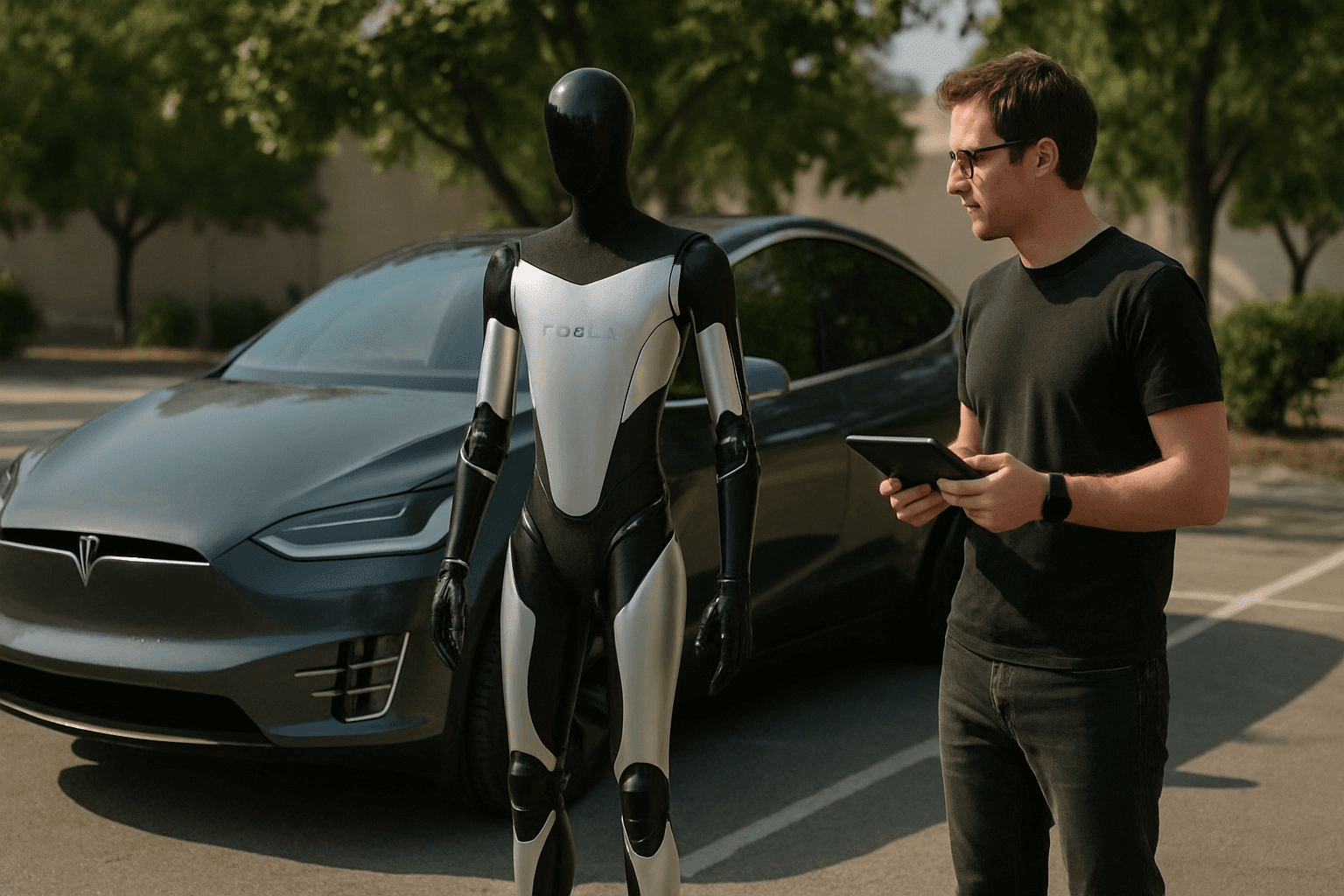
Tesla’s humanoid Optimus
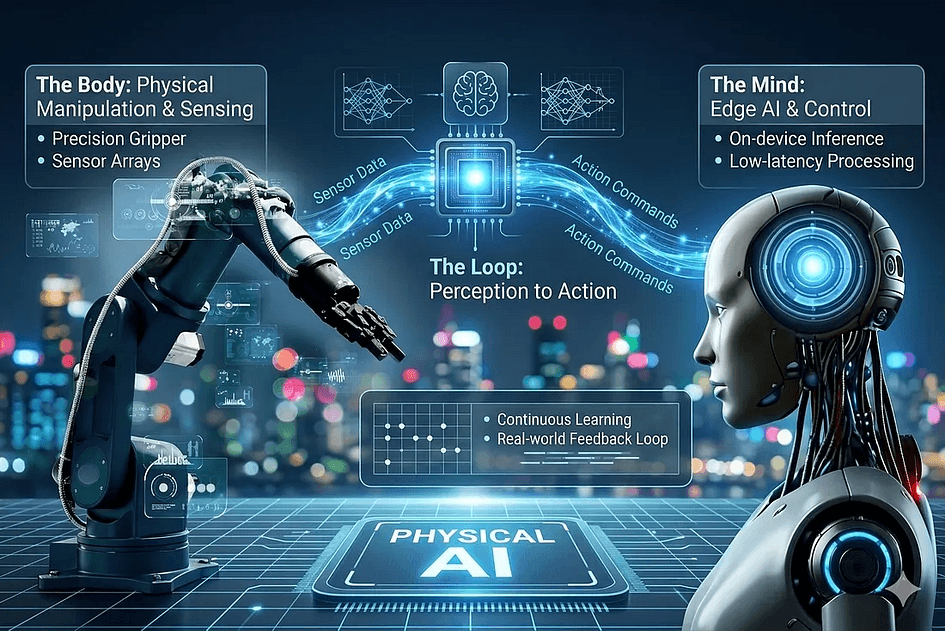
In short, Physical AI is AI that moves and reacts in the actual physical world. Rather than staying confined to the digital domain, it perceives its environment through sensors like cameras, lidar, and microphones; makes decisions based on that information; and produces real-world outcomes through motors, actuators, and displays.
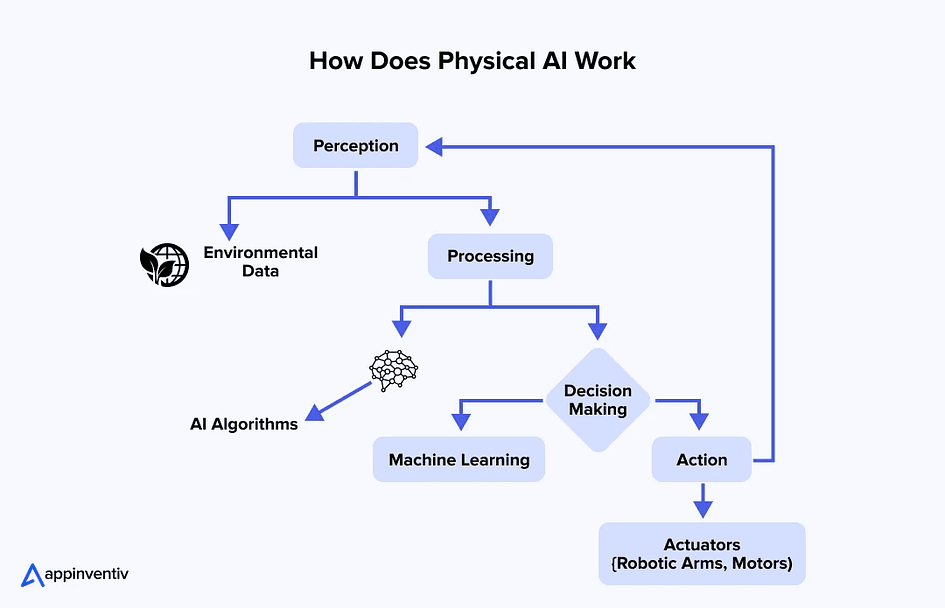
Source: appinventiv
There are three main reasons this field has come to the forefront. First, on the model side, models capable of understanding the real world, such as VLA (Vision-Language-Action) models (which integrate vision, language, and action) are maturing rapidly. Second, on the hardware side, the widespread availability of edge NPUs and low-power SoCs is laying the foundation for on-device execution of models that once required cloud infrastructure. Third, on the industry side, automation demand across manufacturing, logistics, energy, and urban infrastructure has reached a peak, and AI sophisticated enough to actually meet that demand has finally started to emerge.
Core Technologies
Physical AI cannot be completed by a single model. It only comes to life when multiple layers, from brain to body to learning infrastructure, come together in a single stack. A recent report based on Korea’s ICT R&D classification framework groups the core technologies of Physical AI into the following five categories.
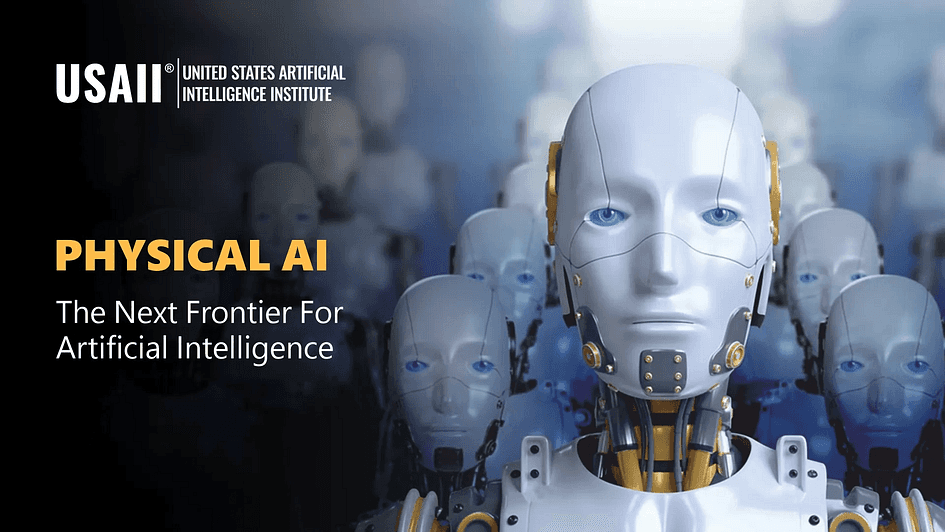
Source: USAII
VLA (Vision-Language-Action) models: The “core brain” that integrates vision, language, and action to handle perception, judgment, and action generation. NVIDIA’s GR00T, unveiled at this year’s GTC, is a representative example.
On-device AI: The “execution layer” that performs robot control at the edge through low-latency, low-power inference. It’s what allows a trained AI model to deliver strong inference performance in real device environments.
Body technologies (sensors and actuators): The “physical layer” that captures environmental information and translates policies into physical action. This spans locomotion and manipulation intelligence as well as situational awareness and judgment, which allows a robot to execute “press the button” without falling over.
Simulation-based training environments: Execution environments for large-scale parallel training, dangerous-scenario training, and Sim2Real correction (techniques for minimizing the gap between simulation and reality). Digital twins and platforms like NVIDIA’s Isaac Sim fall into this category.
Physical AI data factory: The “training infrastructure” that collects, stores, refines, and trains on robot behavior data. The quantity and quality of this data directly determine model performance.
All five must come together for Physical AI to work. But among them, on-device AI is the key that turns the value of every other layer into something real at the edge. No matter how powerful the VLA model, no matter how refined the simulation and data factory, none of it amounts to true Physical AI if you can’t run the result on a real device in real time.
The reason is simple. When a robot is about to bump into a person, or when an autonomous vehicle suddenly encounters a pedestrian, “Hold on, let me check with the cloud” is not an acceptable answer. Beyond the difficulty of guaranteeing real-time performance, network dependency, the risk of data leakage, and the snowballing cost of APIs and cloud instances make cloud-based Physical AI essentially unviable.
For all these reasons, the rise of Physical AI is, in many ways, the rise of on-device AI.
Source: https://medium.com/@mankayarkarasi/the-rise-of-physical-ai-790fc4b1627a
The Rise of Voice User Interfaces
At the center of the physical world Physical AI is meant to perceive, judge, and act in, there is almost always a human. In most situations, Physical AI works on behalf of people in a wide range of contexts: the driver behind the wheel, the worker on the factory floor, the patient in a hospital ward, the family in the living room.
So how should AI in the physical world communicate with people? In the past, the default was a mouse, a keyboard, or a touch panel. But across cars, factories, hospitals, and other environments where AI is increasingly embedded into industry and daily life, the most natural and convenient interface ultimately comes down to voice.
In fact, voice user interfaces are quickly becoming the de facto standard across many of the areas where Physical AI is being actively explored.
Humanoids: Both Figure and Tesla, the leading humanoid developers, have built voice user interfaces into their robots, supporting not only voice-based command execution but also natural, fluid conversation. Building a conversational AI that feels truly natural is extremely difficult, yet neither company is willing to give up on voice. The reason is simple: speech is still the fastest, most comfortable way for humans to communicate.
Source: Tesla Owners Silicon Valley Youtube
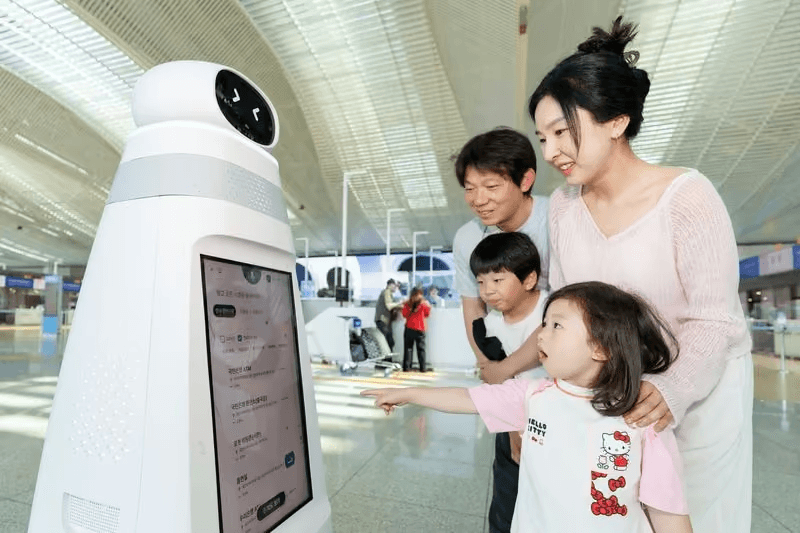
Service robots: The autonomous guidance robots deployed at Incheon International Airport hold natural voice-based conversations with passengers to recommend the optimal route, and switch to patrol mode to handle safety operations when an emergency is detected.
Source: Financial News
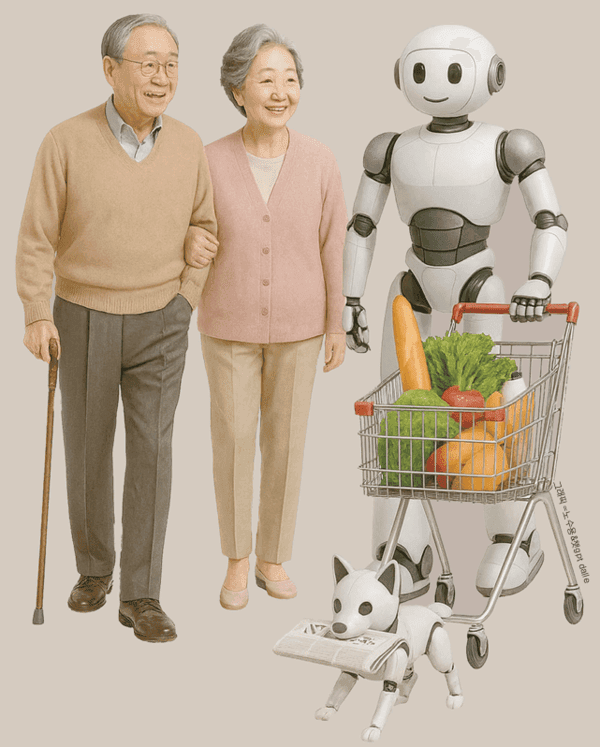
Care robots: Care robots are robots that move and talk inside the home to assist with daily life, designed to support the health, safety, and emotional well-being of seniors. Today’s care robots not only handle reminders for waking up, taking medication, or coming home safely, they also act as conversation partners, providing companionship and emotional connection.
Source: Robot Newspaper
And AI-powered voice user interfaces, too, ultimately need to run on-device. Here’s why.
With cloud, operating costs are impossible to predict: Cloud-based speech APIs typically charge per call, which means cost scales with usag, and usage is hard to forecast. When the same capability runs on-device, no per-use cost is incurred after deployment, making it far more economical over the long run.
Voice data is sensitive personal information: Voice carries more than just the words being spoken. It also captures the speaker’s identity (their voice), their emotional state, and the ambient sounds around them. Transmitting that kind of data to an external server can be a significant liability in itself.
Natural conversation requires real-time responsiveness: The acceptable response gap for a conversation to feel natural is reportedly around 0.2 seconds (200ms). If the voice user interface lives on a cloud or external server, the round-trip for sending audio and receiving the result adds extra latency . And that’s often enough to break the rhythm of a real-time exchange.
For us to talk to AI in our own language during the Physical AI era, the voice user interface that serves as the bridge must be able to listen, understand, and respond in real time , right on the device.
ENERZAi as a Physical AI Company
ENERZAi develops voice and language models that can run with minimal memory on low-spec hardware. Specifically, we deliver voice interfaces that run optimally on CPU alone, even on devices without a GPU or NPU.
This solves the memory bottleneck that nearly every company exploring on-device AI runs into, which is why we’ve been receiving strong interest from semiconductor and device makers. At embedded world held on this March, the world’s largest embedded systems exhibition, we presented a robotics voice-control demo together with global semiconductor company Synaptics. It’s still an early-stage form of Physical AI, but it earned strong reviews for delivering stable performance with minimal memory and power.
At the end of last year, we also signed a strategic partnership with Advantech, a global leader in industrial PCs and AIoT solutions and one of the companies driving Physical AI innovation forward. The partnership pairs Advantech’s proven hardware and deep industrial-domain expertise with ENERZAi’s on-device AI technology, and the two companies are jointly building on-device AI solutions that can be deployed across manufacturing, logistics, smart cities, and other industrial sites.

ENERZAi’s ultimate goal is to achieve true intelligence, AI that can reason on its own and call the right tools, even on the edge rather than the cloud or a remote server. Because this direction connects so naturally with Physical AI’s vision of acting independently in the real world, we’re committed to building the on-device AI that turns Physical AI into reality.
If you’re considering on-device AI for your own product or platform, or exploring potential collaboration around Physical AI, please feel free to reach out anytime!